01 · Diffusion and absorption

Modular Diffuser

Organic wave diffuser for the back wall of the room.

box
750 × 285 × 350 / 500 / 600 / 700 mm
wells
12 per box, 16 depth steps
range
from 545 / 370 / 305 / 260 Hz to ~2.9 kHz (calculated)
wall
any size, e.g. 3000 × 1995 mm
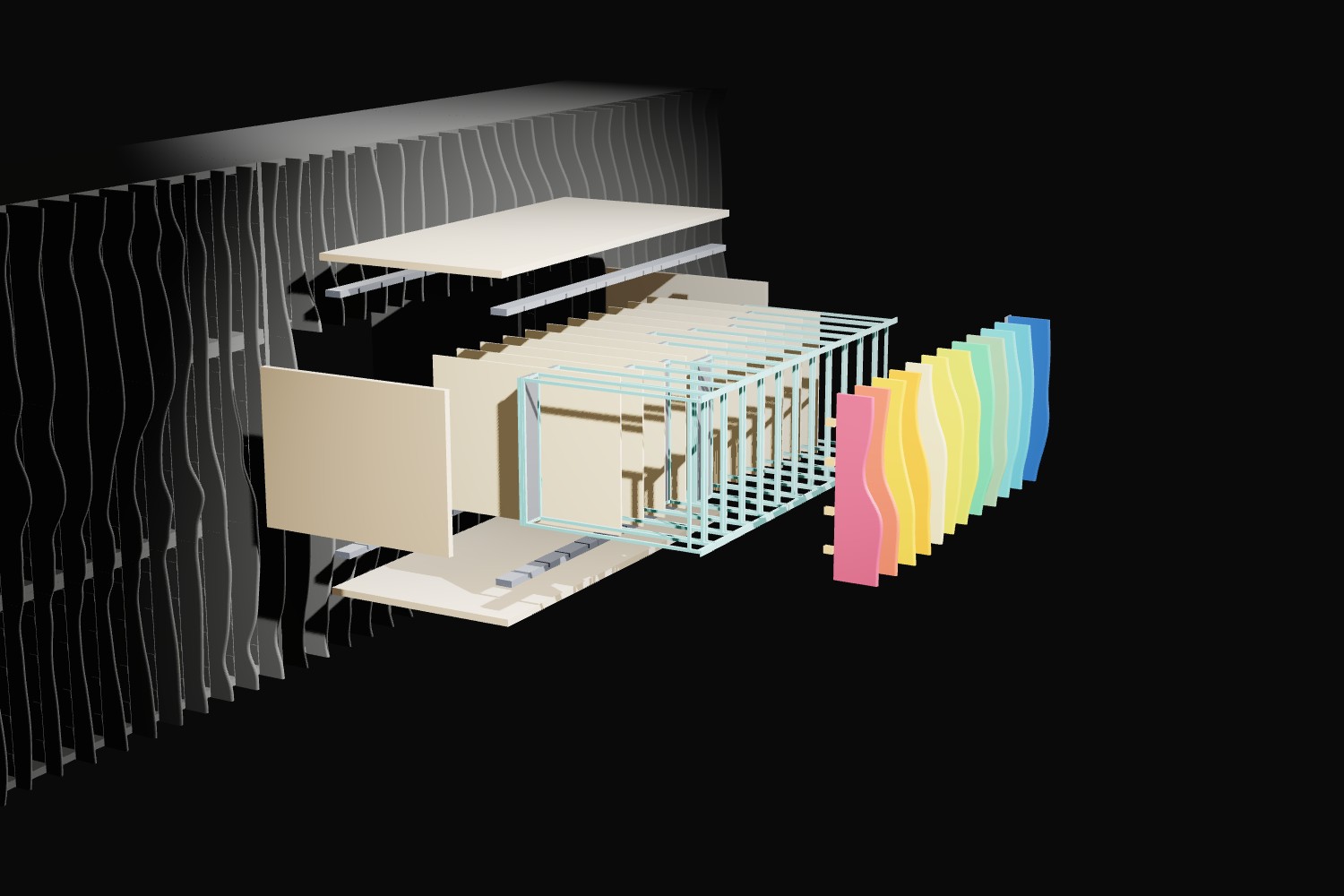
Modular Diffuser, one box exploded

Overview

How it works

One box type, four depths. The deeper the box, the lower the diffuser starts to work. Everything else stays the same: the face, the wells, the waves and the way the boxes join.

Each box holds 12 wells side by side, separated by thin plywood fins. Sound goes into a well, bounces off its floor and comes back out, late by twice the well depth. Neighbouring wells have different depths, so the parts of the reflection leave the face out of step with each other. They no longer add up to one mirror-like reflection. Instead the energy spreads over many directions in the horizontal plane.

Lowest frequency

A well starts to work when its depth reaches about half a wavelength. So the deepest well sets the bottom of the range:

flow ≈ c / (2 · dmax) c = 343 m/s, dmax = deepest well

Highest frequency

Above the point where half a wavelength fits across a well, sound no longer travels straight down the well. With 58.5 mm wells:

fhigh ≈ c / (2 · w) ≈ 343 / (2 × 0.0585) ≈ 2.9 kHz

The waves

The printed caps on the fins stand 14–92 mm out of the face, and their height changes along the wall. The front of the diffuser is never a flat plane. The aim is to keep the top of the range from turning into a flat-panel reflection. Their effect is part of the planned measurements.

Depths

The configurator snaps every well to one of 16 depth steps, from 95 mm to the deepest well of the box. So a whole wall needs at most 16 drawer types, plus narrow versions for the wells next to the side walls.

Section through five wells of different depth, with sound going in and coming out delayed w = 58.5 mm front depth d floor fin
Section through five wells, seen from above. A reflection comes back from each floor, late by 2 · d. Different depths put the reflections out of step, and that spreads the sound.

Figures

Sizes and numbers

Box depthDeepest wellDesign rangeBox weightScrews per cornerLongest drawer
350 mm314 mm545 Hz – 2.9 kHz≈ 11.5 kg3one piece
500 mm464 mm370 Hz – 2.9 kHz≈ 15 kg4may be printed in 2 pieces
600 mm564 mm305 Hz – 2.9 kHz≈ 17.5 kg4may be printed in 2–3 pieces
700 mm664 mm260 Hz – 2.9 kHz≈ 20 kg4may be printed in 2–3 pieces

Calculated, not measured

All frequencies on this page are calculated from the geometry, not yet measured. Lab measurements (scattering and diffusion coefficients) are planned, and this page will show them once they are done.

Safety

The wall must be anchored. Always fix the top row to the room wall with the top anchors (printed, or metal anti-tip straps), as the assembly manual shows. A wall of boxes is heavy and it is taller than it is deep. Safety information →

Build

Details

  • 01Every box is 750 × 285 mm on the face, with 12 wells 58.5 mm wide (48.5 mm next to the side walls). Walls 12 mm birch plywood, fins 4 mm, well floors 6 mm.
  • 02Weight. Plywood at about 680 kg/m³ plus the printed parts in PETG. A wall of 4 × 7 boxes weighs about 320 kg at 350 mm and about 560 kg at 700 mm.
  • 03Printed parts per box. 12 combs, 12 drawers, 13 waves. Long drawers are split to fit your printer, and the pieces push together.
  • 04Drawers click into the front combs and cover the ends of the fins. The fins stop against the back combs. They are there so that nothing creeps out over time, even in a loud room.