02 · Diffusion and absorption

Absorber Panel

Mineral wool in a plywood frame, for walls, ceilings, edges, corner traps and the floor.

size
300–1200 mm each, joined into any size
wool
50–400 mm, with air behind it
range
from about 130 Hz up with 100 mm and 50 mm of air (calculated)
package
cut list, hardware, print files for your printer, manual
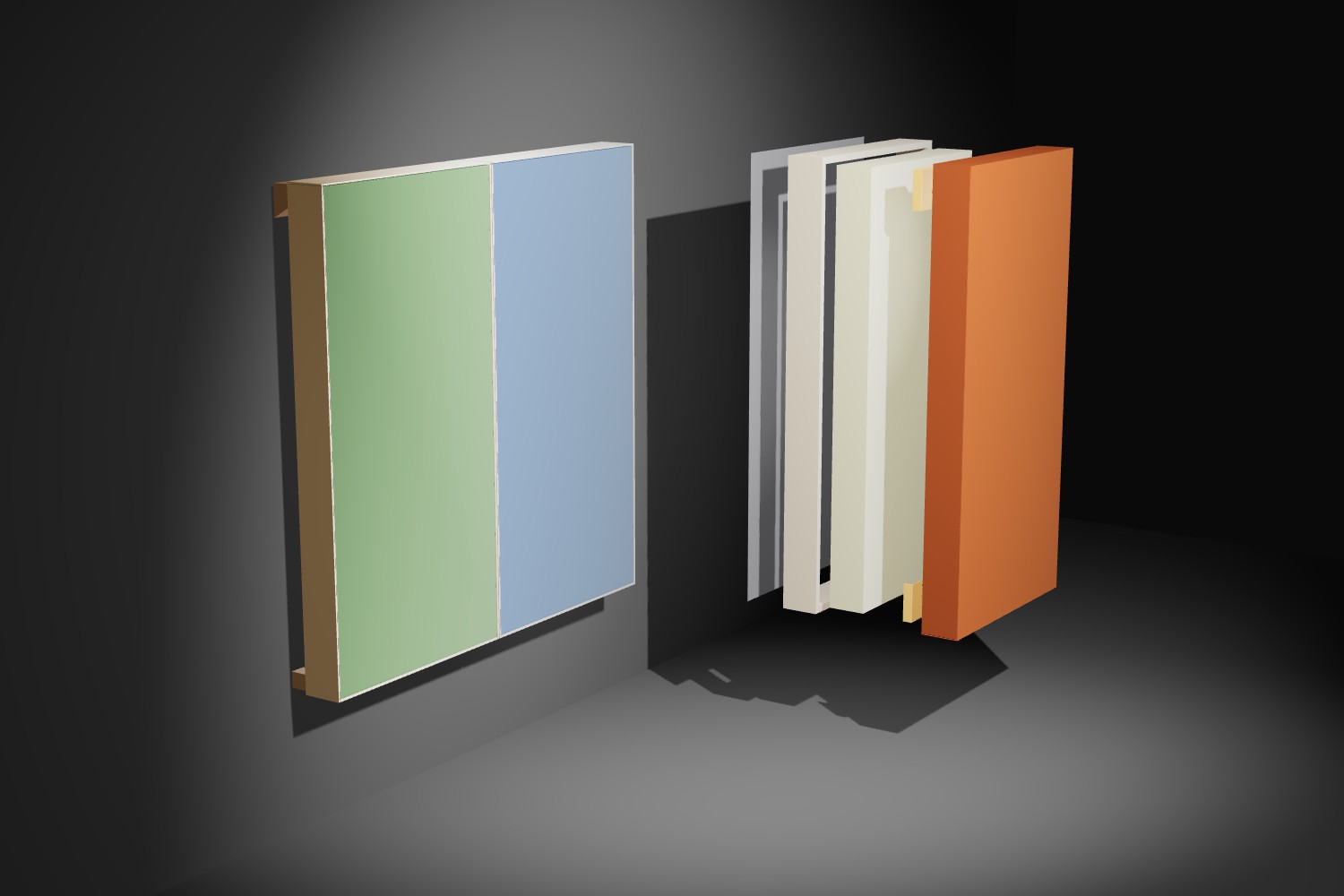
Absorber panels on a wall, one opened

Overview

How it works

One panel, five places: a wall, a ceiling cloud, a wall–ceiling edge, the front of a corner bass trap, the floor. The panel is always the same; only the printed mounting parts change.

Sound moving through mineral wool rubs against its fibres and turns into heat. Thicker wool reaches lower notes. Air behind the wool does the same job: at low frequencies the air moves most a quarter of a wavelength away from the wall, so a panel held off the wall works lower than its thickness alone.

f ≈ c / (4 · (d + g)) roughly where it starts to work well: d = wool, g = air behind, c = 343 m/s

Where

On the side walls and the ceiling where the first reflections from the speakers hit, on the floor between the speakers and your seat, and across the corners, where it adds to the membrane traps behind it.

Built simply

The frame is plywood ripped to the wool thickness and butt-jointed: no angled cut anywhere. Printed braces square every corner and hold the wool; printed 45° wedges meet the walls and ceilings.

A panel on a wall, in section: the wall, the cleats, the air, the frame, the wool and the fabric wallcleatsat 30° mineral woolframefabric air gwool d sound
On a wall, in section. The panel hangs on a cleat and lifts off; the air behind it lets it work lower.

Figures

Sizes and numbers

WoolNo air50 mm air100 mm air200 mm air600 × 1200 panel
50 mm480 Hz · 0.7235 Hz · 0.8153 Hz · 0.989 Hz · 0.9≈ 4.4 kg
100 mm198 Hz · 0.8130 Hz · 0.998 Hz · 0.965 Hz · 0.8≈ 8.2 kg
150 mm122 Hz · 0.994 Hz · 0.978 Hz · 0.961 Hz · 0.9≈ 12.1 kg
200 mm90 Hz · 0.978 Hz · 0.971 Hz · 0.966 Hz · 0.9≈ 16 kg
300 mm61 Hz · 0.953 Hz · 0.947 Hz · 0.939 Hz · 0.9≈ 23.7 kg
400 mm45 Hz · 0.942 Hz · 0.939 Hz · 0.935 Hz · 0.9≈ 31.5 kg

Calculated, not measured

Each cell: from which frequency it absorbs half or more of the sound, and the NRC. Mineral wool 40–60 kg/m³ up to 200 mm, a lighter one (30–40 kg/m³) above, or the low notes bounce off its face. Sound straight on, averaged over a third of an octave. Calculated, not yet measured. Measurements are planned, and this page will show them once they are done.

Safety

Anything over your head hangs on metal. A cloud hangs on four steel cables to ceiling anchors that hold the load; the rails across a ceiling edge go into joists or concrete. Wear gloves and a dust mask when you cut mineral wool. Safety information → · Configure →

Build

Details

  • 01Frame. 18 mm birch plywood ripped to the wool thickness (50–400 mm; across an edge or a corner up to 200 mm), sides the full length, ends between them, glue and screws. Each panel 300–1200 mm each way: a bigger surface is several panels joined, easier to carry and to put up.
  • 02Printed corner braces on the front of every corner of every bay: they square the frame and hold the wool, up to 90 mm over it (they grow with the bay and the wool). The back stays open: printed turn buttons hold the back cloth and the wool, and turn out to change it. Acoustic fabric in the colour you choose, glued and stapled round the front and sides; thin hardwood trims over it on the edges (all four, left and right, or none).
  • 03Joining. For a cloud or the floor, printed plates across the back of every joint, so several panels behave like one. On a wall every panel hangs alone and can be moved.
  • 04Mounting. On a wall a cleat, a batten along the wall cut at 30° with its mirror on the panel, wood or printed, the panel lifts off and moves (air 18–100 mm); steel cables for a ceiling cloud; 45° wedges on dovetail rails across a wall–ceiling edge or a room corner, with bumpers on the corner trap's front; feet on the floor.
  • 05Printed jigs. Square corner, bay spacers, drill guide for the frame screws, wedge setter. The configurator gives the cut list, the hardware, the print files for your printer and the weight.