04 · Bass traps

Floor Bass Trap

Membrane bass trap that stands under a column of diffusers, or on its own.

size
750 × 350 standard; any width and height
depth
same as the diffusers
range
peak about 95 Hz at 750 × 350 × 350 (calculated)
package
cut list, hardware, print files for your printer, manual
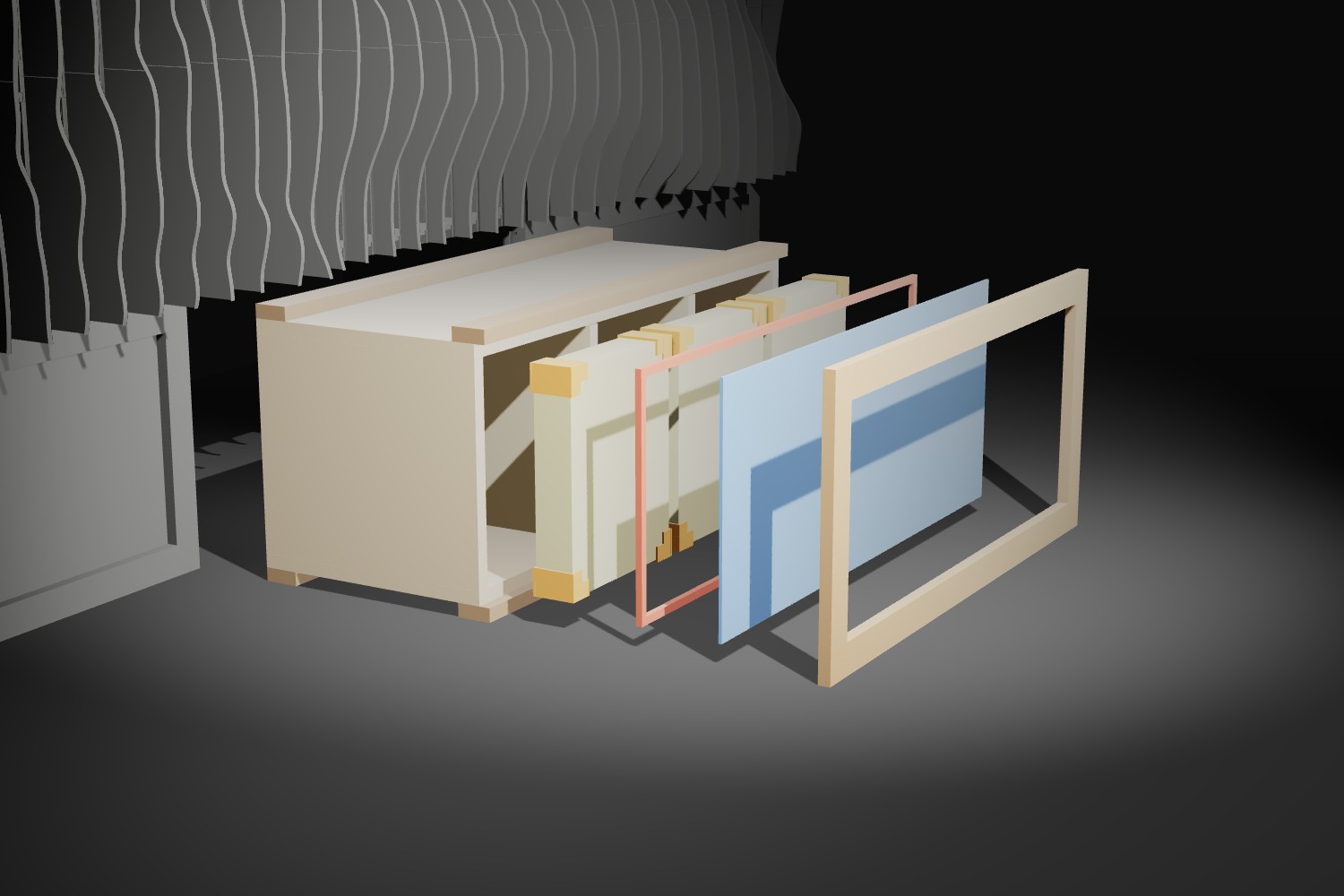
Floor bass trap, opened

Overview

How it works

A closed plywood box with a thin plywood membrane on the front. It stands on four hardwood strips, under a column of diffusers or on its own. Same face and same depths as the diffuser boxes, so a whole wall lines up.

The membrane sits on a soft gasket around the front edge of the box. Low sound pushes the membrane in and out, and the air in the box behind it acts as a spring. At one frequency the membrane and the air spring move the most. There the sound energy turns into movement and heat in the gasket and in the mineral wool inside, and less of it comes back into the room.

The peak

For a membrane of mass m (kg/m²) in front of an air layer d (m), the classic estimate is:

f0 ≈ 60 / √(m · d) 50 instead of 60 when the box has wool inside

What moves it

A deeper box (more air) or a heavier membrane moves the peak down. The mass sheet option adds weight to the membrane. The stiffness of the membrane and of the gasket push it up a little, and the configurator adds both.

Inner walls

The box is split into cells, at least 100 mm wide. They stop the air from sliding sideways behind the membrane and keep the membrane moving as one piece. They also make the box stiff, so the box itself does not ring.

Wool

A sheet of mineral wool in each cell, held a few millimetres behind the membrane by printed brackets. It widens the working range and lowers the peak a little.

Side section through the front of the bass trap: box wall, gasket, membrane, air gap, frame and strips sound membrane wool air back gasket frame strips floor
Side section, the room on the right. The membrane rests on the gasket and is held by the frame, 2.5 mm away. The strips under the box keep it level and lift it off the floor.

Figures

Sizes and numbers

SizeAir behind the membranePeakWorking rangeWeightScrews
750 × 350 × 350 mm311 mm95 Hz81 – 111 Hz≈ 16.2 kg84
750 × 350 × 500 mm461 mm87 Hz74 – 102 Hz≈ 21.0 kg92
750 × 350 × 600 mm561 mm84 Hz71 – 98 Hz≈ 24.2 kg100
750 × 350 × 700 mm661 mm81 Hz69 – 95 Hz≈ 27.4 kg100
750 × 285 × 350 mm311 mm109 Hz93 – 127 Hz≈ 14.3 kg80
750 × 285 × 500 mm461 mm102 Hz87 – 119 Hz≈ 18.6 kg88
750 × 285 × 600 mm561 mm99 Hz85 – 116 Hz≈ 21.5 kg96
750 × 285 × 700 mm661 mm97 Hz83 – 114 Hz≈ 24.4 kg96

Calculated, not measured

Two heights: 350 mm, the standard (as in the picture above), and 285 mm, the height of one diffuser box. Both with 3 cells, 4 mm plywood membrane, 8 mm EPDM sponge gasket and 50 mm mineral wool. All frequencies are calculated, not yet measured. The real peak depends on the plywood, the gasket and how tight the frame is. Measurements are planned, and this page will show them once they are done.

Safety

Do not stand on the trap and do not press the membrane. A diffuser column above it must still be anchored to the wall, as the diffuser manual shows. Safety information → · Configure →

Build

Details

  • 01Body 18 mm plywood. Bottom, top, two sides, back and the inner walls, glued and screwed with 4 × 40 mm screws. The trap carries the diffusers above it.
  • 02Four hardwood strips 18 × 45 mm, across the whole width: the two at the front hold the frame, the two at the back keep the trap level. The same strips on the top take the diffuser box above.
  • 03Frame 15 mm, 40 mm wide, screwed into the front strips. It holds the membrane on the gasket without clamping it.
  • 04Printed parts. Corner brackets for the wool (4 per cell) and a wide U bracket in the middle when the wool is in two pieces. Five printed jigs set the depths, the gasket line, the inner wall spacing, the membrane gap and the screw lines.
  • 05Any width from 400 to 1500 mm and any height from 150 to 600 mm. The standard 350 mm trap has a bigger membrane, so it works about 15 Hz lower than a 285 mm one. The configurator gives the cut list, the hardware, the print files for your printer and the lists for your size.